Eric Glandian – Food Business Blueprint
Eric Glandian – Food Business Blueprint Launching a food business is one challenge, but scaling it into a profitable brand with retail distribution is an entirely different journey. Eric Glandian’s Food Business Blueprint is designed to help established food entrepreneurs bridge that gap by providing practical systems, real-world documents, and implementation strategies based on Eric’s experience growing Zen Monkey Overnight Oats from startup to multi-million-dollar annual sales and distribution in thousands of retail stores. The program is hosted on Skool and combines recorded training, live coaching, practical templates, and a private community for food business owners.
Unlike introductory business courses, this program targets founders who already have a minimum viable product (MVP) with consumer-ready packaging and active sales. Rather than teaching recipe creation or product development from scratch, it focuses on scaling operations, improving retail opportunities, managing production, marketing products, and building systems that support long-term growth.
If you already have a food product on the market and want structured guidance for expanding into wholesale, retail, or larger production, Food Business Blueprint aims to provide practical frameworks instead of generic entrepreneurial advice.
Course Description
Eric Glandian – Food Business Blueprint
Eric Glandian – Food Business Blueprint Course Review
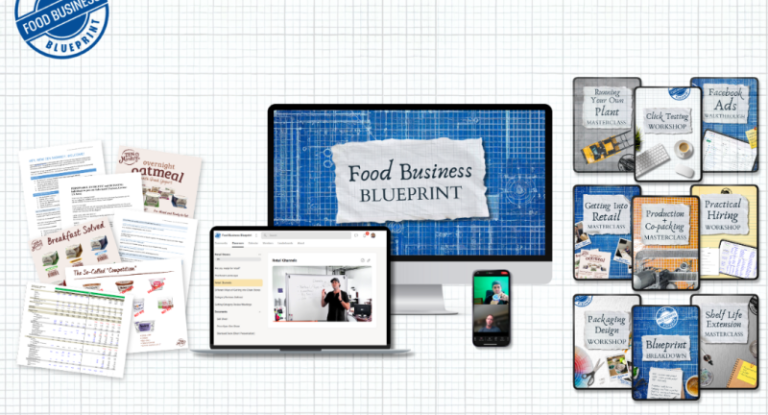
Eric Glandian’s Food Business Blueprint positions itself as an implementation-focused program rather than a collection of motivational videos. From the publicly available information, the course emphasizes actionable strategies that Eric personally used while building Zen Monkey Overnight Oats into a nationally distributed consumer packaged goods (CPG) brand. Instead of presenting only theoretical concepts, members receive access to real spreadsheets, emails, presentations, screen recordings, and live coaching sessions that demonstrate how decisions are made inside an operating food business.
One of the strongest aspects of the course is its practical focus. Topics extend beyond marketing into production, packaging, retail sales, broker relationships, hiring, machinery, co-packers, shelf-life management, online sales, and investor preparation. These are challenges that many growing food brands eventually face but are often overlooked in general business courses.
The teaching style appears straightforward and implementation-oriented. Rather than overwhelming students with abstract business theory, Eric shares real examples from his own company. This approach may help learners understand how strategies work in real business situations rather than simply reading about them.
However, the course is not intended for complete beginners who only have a business idea. One enrollment requirement is having an MVP, including consumer-ready packaging and active product sales. This means entrepreneurs still validating recipes or exploring concepts may need earlier-stage education before joining.
What You’ll Learn
- Build a structured roadmap for scaling an existing food business beyond its early stages.
- Understand how retail distribution works and prepare your business for wholesale opportunities.
- Learn practical production and operations systems that support sustainable growth.
- Improve packaging, shelf-life planning, and product positioning for retail success.
- Discover strategies for online sales, paid advertising, and customer acquisition.
- Understand how to work with brokers, co-packers, manufacturers, and retail buyers.
- Access practical templates, spreadsheets, presentations, and business documents to simplify implementation.
- Develop systems for hiring, operations, and long-term business expansion.
What is the Course?
Food Business Blueprint is a specialized online training program and business community created by Eric Glandian, an entrepreneur who built Zen Monkey Overnight Oats into a nationally distributed consumer packaged goods brand. Hosted on the Skool platform, the program is designed for founders who already have a market-ready food product and want to scale their operations using proven business systems instead of relying on trial and error.
Rather than teaching how to create recipes or launch a food business from scratch, the course focuses on the operational, financial, marketing, and retail aspects of growing an existing company. Members gain access to recorded lessons, screen-share walkthroughs, downloadable templates, real business documents, and live coaching sessions that cover topics such as production, packaging, online sales, retail distribution, hiring, investor readiness, machinery, and manufacturing decisions.
The program encourages implementation through practical resources and an active entrepreneur community. Because it is intended for businesses that already have a minimum viable product, the lessons are tailored toward scaling rather than initial product development.
Who Is This Course For?
Food Business Blueprint is best suited for entrepreneurs who already operate a food or consumer packaged goods business and are looking for structured guidance to grow beyond the startup phase. It is particularly valuable for founders who have validated their products, completed consumer-ready packaging, and are actively selling through local stores, farmers markets, direct-to-consumer channels, or online platforms.
The course may benefit business owners preparing for larger retail opportunities, improving manufacturing processes, optimizing packaging, building stronger marketing systems, or expanding distribution. It can also be useful for founders seeking practical advice on working with brokers, co-packers, investors, and production partners while building scalable operations.
However, individuals who only have an idea, recipe, or concept without an existing product may find the course too advanced for their current stage. Since membership requires an MVP, complete beginners may first need foundational education before benefiting from the strategies taught inside the program.
Why Choose This Course?
Food Business Blueprint stands out because it is designed specifically for food entrepreneurs rather than general online business owners. Many entrepreneurship courses teach universal marketing or sales principles, but this program addresses the unique operational challenges involved in manufacturing, packaging, distributing, and scaling physical food products.
Another reason to consider the course is Eric Glandian’s practical experience building Zen Monkey Overnight Oats into a nationally distributed consumer packaged goods brand. Instead of relying only on theory, the training is built around systems, workflows, and business decisions that have been tested in a real operating company. This practical perspective can be valuable for entrepreneurs looking for implementation-focused education.
The course also emphasizes actionable learning by providing templates, spreadsheets, presentations, and real business documents that members can adapt to their own companies. Combined with live coaching and community discussions, these resources create an environment that supports continuous learning rather than isolated video lessons.
For founders who already have a validated product and are preparing for larger retail opportunities, Food Business Blueprint offers industry-specific education that is often difficult to find in broader entrepreneurship programs.
Pros & Cons
Pros
- Industry-specific training created for food business owners.
- Focuses on practical implementation rather than motivational content.
- Includes real business templates, spreadsheets, and operational resources.
- Live coaching sessions provide opportunities for personalized guidance.
- Private community encourages networking and collaborative learning.
- Covers multiple areas including production, marketing, retail, and operations.
- Suitable for founders preparing to scale an existing food business.
- Based on real entrepreneurial experience within the consumer packaged goods industry.
Cons
- Not suitable for entrepreneurs who only have a business idea or recipe.
- Highly specialized content may have limited value outside the food industry.
- Success still depends on execution, market demand, and operational decisions.
- Some advanced topics may require additional independent research as businesses continue to grow.
Eric Glandian – Food Business Blueprint Main Benefits
- Learn practical systems for scaling a food business instead of relying solely on trial and error.
- Gain insights from an entrepreneur who has successfully grown and managed a nationally distributed food brand.
- Understand retail distribution processes, wholesale relationships, and strategies for expanding into larger markets.
- Access downloadable business templates, operational documents, and planning resources that save time during implementation.
- Improve production planning, inventory management, and manufacturing workflows as your business grows.
- Learn marketing strategies specifically designed for consumer packaged goods instead of generic online businesses.
- Participate in live coaching sessions where you can receive guidance on real business challenges.
- Connect with a community of food entrepreneurs who share similar goals and operational experiences.
- Develop systems that support sustainable business growth rather than short-term sales increases.
- Build greater confidence when making decisions related to operations, retail expansion, hiring, and long-term planning.
Eric Glandian – Food Business Blueprint Honest Review
Food Business Blueprint appears to be a thoughtfully designed program for entrepreneurs who are serious about growing an existing food business. Instead of trying to appeal to every type of business owner, Eric Glandian focuses on a very specific audience—founders with a market-ready product who need guidance on scaling operations, expanding distribution, and building sustainable systems. This narrow focus is one of the course’s biggest strengths because the advice is directly relevant to the challenges faced by food brands.
One of the most valuable aspects of the program is its emphasis on practical implementation. Rather than presenting abstract business theories, Eric shares real documents, templates, presentations, and operational workflows drawn from his own experience building Zen Monkey Overnight Oats. These resources can help entrepreneurs understand how business decisions are applied in real-world situations.
Another advantage is the combination of recorded lessons, live coaching, and an active Skool community. Learning alongside other founders creates opportunities to ask questions, receive feedback, and gain different perspectives on common business challenges.
However, prospective students should understand that this course is not intended for absolute beginners. Individuals who have not yet developed a product, validated demand, or created consumer-ready packaging may find the material difficult to apply immediately. Likewise, entrepreneurs outside the consumer packaged goods industry may benefit more from broader business education.
Frequently Asked Questions (FAQ)
1. What is Eric Glandian’s Food Business Blueprint?
Food Business Blueprint is an online coaching program and business community created by Eric Glandian. It is designed to help founders of existing food businesses improve operations, expand retail distribution, strengthen marketing systems, and build scalable processes using practical frameworks and real-world business experience.
2. Who should enroll in Food Business Blueprint?
The course is intended for entrepreneurs who already have a food product with consumer-ready packaging and active sales. It is especially valuable for founders preparing to expand into retail stores, improve production systems, or grow their consumer packaged goods business beyond the startup stage.
3. Is Food Business Blueprint suitable for beginners?
The program is not designed for complete beginners who only have a business idea or recipe. Since the course focuses on scaling an existing business, students should already have a minimum viable product and some level of market validation before joining.
4. What topics are covered in the course?
The training explores food business operations, retail distribution, manufacturing, packaging, marketing, online sales, hiring, production planning, business systems, co-packer relationships, and scaling strategies. Members also gain access to templates, live coaching, and community discussions.
5. Does the course include coaching and community support?
Yes. Members receive access to live coaching sessions along with a private Skool community where they can ask questions, share experiences, receive implementation feedback, and network with other food entrepreneurs facing similar business challenges.
6. Is Food Business Blueprint worth buying?
Its value depends on your business stage. Entrepreneurs with an established food product who want industry-specific guidance may find the course highly relevant. Those who are still developing an idea or entering a different industry may benefit more from beginner-focused business education.
7. Can this course guarantee business growth or retail success?
No. Like any educational program, Food Business Blueprint cannot guarantee business growth, retail partnerships, or financial results. Success depends on many factors, including product quality, market demand, operational execution, competition, and consistent implementation of the strategies taught.
Final Verdict
Eric Glandian’s Food Business Blueprint is a specialized educational program designed for food entrepreneurs who are ready to move beyond the early stages of business and build a more scalable operation. Instead of offering broad entrepreneurial advice, the course concentrates on the unique challenges involved in growing a consumer packaged goods (CPG) brand, including production, retail distribution, operations, marketing, and long-term business systems.
One of the strongest aspects of the program is its emphasis on practical implementation. Eric shares lessons drawn from building his own food company, along with business templates, operational resources, and real-world examples that members can adapt to their own businesses. The addition of live coaching sessions and an active Skool community further enhances the learning experience by allowing entrepreneurs to ask questions and learn from others in similar situations.



Reviews
There are no reviews yet.